
0xKYC
Privacy-preserving Web3 identity verification using zero-knowledge proofs that runs inside Zenoo flows.
At a glance
Overview
0xKYC overview
0xKYC provides privacy-preserving identity verification for Web3, using zero-knowledge proofs so users can prove they passed KYC without exposing personal data on-chain. It suits DeFi protocols and crypto startups that need wallet-linked, reusable verification. Community reports position it as a lower-cost option for Web3 use cases, with trade-offs at higher volumes.
- Company
- 0xKYC
- Category
- Identity verification
- Strongest in
- Privacy-preserving Web3 verification
- Best fit
- DeFi and crypto startups at lower volumes
Where it is strongest
Key strengths
What 0xKYC does well.
Privacy-preserving by design
Zero-knowledge proofs let users demonstrate verified status on-chain without revealing underlying identity data.
Built for Web3 flows
Community reports describe a modular design that works well with wallet-based authentication, smart contracts, and soulbound token gates with reusable proofs.
Quick to integrate for basic flows
Developers report standing up basic Web3 KYC flows in days rather than weeks.
Cost-effective for crypto projects
Community reports cite per-verification pricing well below traditional KYC providers for Web3 workloads.
Who it suits
Best for
Where 0xKYC fits, and what to plan for.
Honest notes on the trade-offs, each with a way to cover the gap inside a Zenoo flow.
- Web3 startups running lower-volume KYC where privacy is a differentiator
- DeFi protocols that need wallet-linked, reusable verification proofs
- Cost-sensitive crypto projects with straightforward compliance requirements
- Document coverage varies by region. Some reports suggest higher rejection rates for non-Western identity documents. In a Zenoo flow you can route those users to a fallback verification provider automatically, so a rejection never ends the journey.
- Reliability at higher volumes. Community reports describe intermittent proof-generation issues under heavy load. Zenoo's fallback routing keeps onboarding running by switching providers when response times degrade.
- Documentation and support depth. Developers have described the documentation as thin in places, with support running through community channels. Activating through Zenoo means our AI builds and maintains the connector, so your team is not dependent on vendor documentation.
- Compliance depth for regulated finance. Some reports suggest gaps for traditional finance requirements such as Travel Rule support. Pairing 0xKYC with a dedicated AML and blockchain analytics provider in the same flow covers regulated use cases.
Open the customer's case
What your team sees
The 0xKYC result, beside everything else.
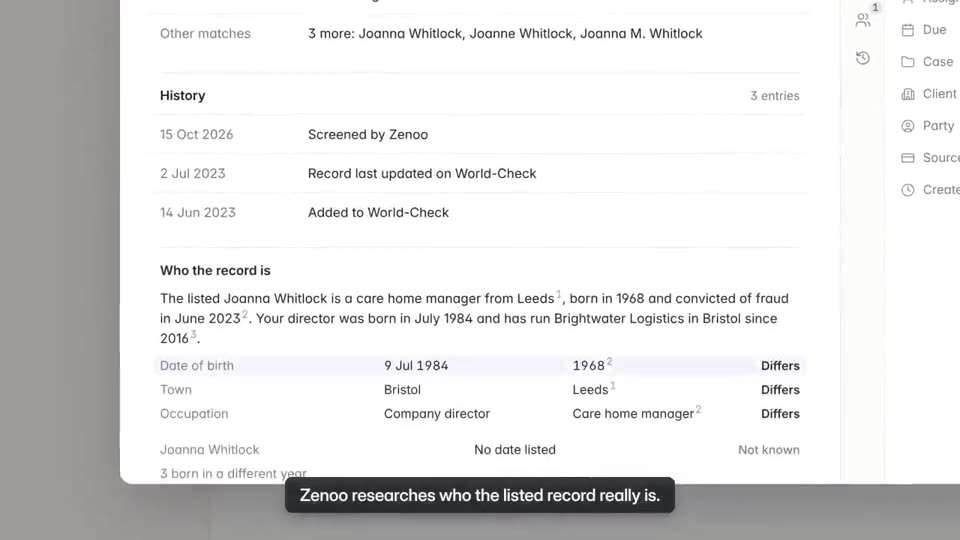
The result sits with screening and review on one case, so nobody checks a second tool to see the whole customer.
What you can build
- Privacy-preserving KYC gates for DeFi protocols
- Reusable verification proofs for wallet-based onboarding
- Token-gated access where holders prove verified status without exposing identity
Hands it to your team
Verification is the first step. Compliance Hub handles the rest.
Once a customer is verified, screening and review happen in Compliance Hub. A possible PEP match lands in your team inbox with the evidence and the full history beside it. Zenoo suggests, your team decides.
Pairs well with
 ChainalysisAdd wallet screening and blockchain analytics in the same flow.VE
 VeriffRoute users with unsupported documents to a fallback identity verification provider.
Alternatives
More in identity verification


Tomorrow, your case
Bring us a case that went wrong.
We will run it through Zenoo while you watch: the evidence, the decision, and the record your MLRO would want to defend.
30 minutes. Your data. No slides.