
Verify
Enhance your financial verification processes with Zenoo integrated with TrueLayer Verification, ensuring accuracy and compliance.
At a glance
Overview
Verify overview
TrueLayer's Verify product uses open banking to confirm bank account ownership in real time: the applicant authenticates with their bank, and the account name and details come back verified at source. That removes a common fraud and error point in payouts, lending, and wallet funding. Through Zenoo it runs as a pre-built connector inside your onboarding flows.
- Company
- TrueLayer
- Category
- Open banking
- Strongest in
- Real-time UK and EU bank account ownership verification
- Best fit
- Flows where misdirected payments or account fraud are costly
Where it is strongest
Key strengths
What Verify does well.
Verification at source
Account ownership is confirmed against live bank data rather than uploaded statements, which is faster for users and harder to fake.
Established UK and EU open banking network
TrueLayer is one of the established European open banking providers, with certified security practices including ISO 27001 and SOC 2 reporting.
Less friction than document collection
Users authenticate with their bank in seconds instead of uploading proof-of-account documents.
Who it suits
Best for
Where Verify fits, and what to plan for.
Honest notes on the trade-offs, each with a way to cover the gap inside a Zenoo flow.
- UK and EU onboarding flows that need verified bank account ownership
- Payouts, lending, and wallet funding where misdirected payments are costly
- Teams replacing manual proof-of-account document collection
- Coverage depends on bank connections. Open banking coverage varies by bank, and connection quality can change as banks move between beta and general availability. Zenoo fallback logic routes users to an alternative verification method when a connection is unavailable.
- UK and EU centred. Coverage is strongest in the UK and Europe. For other regions, pair a different account verification method in the same flow.
- One signal, not full KYC. Bank account verification confirms account ownership, not identity documents or sanctions status. Most teams run it alongside document verification and screening.
Open the customer's case
What your team sees
The Verify result, beside everything else.
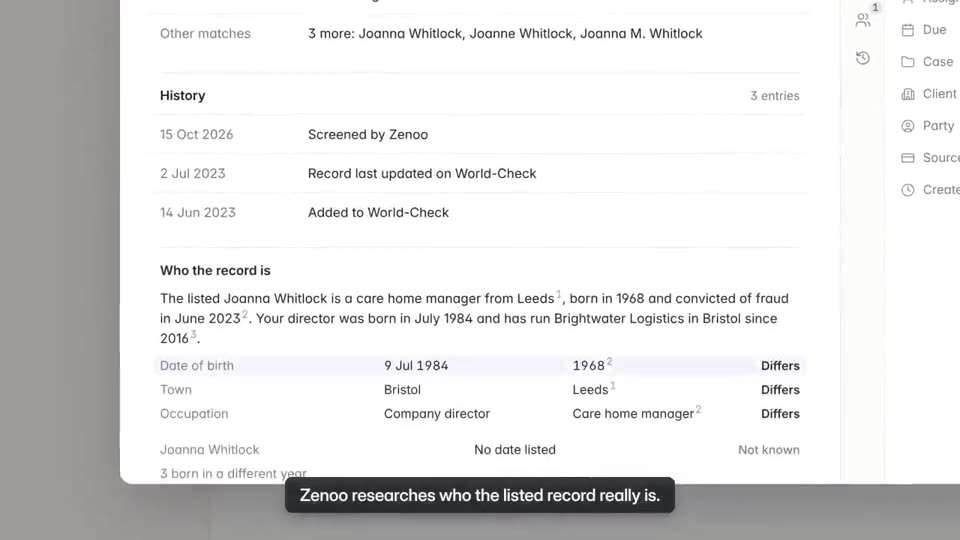
The result sits with screening and review on one case, so nobody checks a second tool to see the whole customer.
What you can build
- Verifying account ownership before first payout
- Bank-verified onboarding for lending and wallet funding
About Verify
FAQs
Verify questions.
How does TrueLayer Verify work with Zenoo?
Through a pre-built connector. Configure it in no-code Studio, add fallback logic, and get one contract and a unified audit trail across every provider in the flow.
What does TrueLayer Verify actually check?
It confirms that a bank account exists and belongs to the applicant, using open banking data returned directly from the bank after the user authenticates. It replaces uploaded bank statements and manual account checks.
What happens if a user's bank connection fails?
In a Zenoo flow, fallback logic catches the failure and routes the user to an alternative method, such as document-based proof of account, so the journey completes instead of stalling.
Hands it to your team
Verification is the first step. Compliance Hub handles the rest.
Once a customer is verified, screening and review happen in Compliance Hub. A possible PEP match lands in your team inbox with the evidence and the full history beside it. Zenoo suggests, your team decides.
Pairs well with
 SumsubScreen the account holder for sanctions, PEPs, and adverse media alongside account checks.CO
 ComplyAdvantageScreen verified customers against sanctions and PEP data.PO
 PowerCurve OriginationsFeed verified account and affordability data into credit decisioning.
Alternatives

More in open banking


Tomorrow, your case
Bring us a case that went wrong.
We will run it through Zenoo while you watch: the evidence, the decision, and the record your MLRO would want to defend.
30 minutes. Your data. No slides.