
Device-First Fraud Intelligence
Spot fraud with SHIELD's device fingerprinting and risk intelligence, available as a pre-built connector in Zenoo flows.
At a glance
Overview
Device-First Fraud Intelligence overview
SHIELD is a device-first fraud intelligence provider. Its Device Fingerprinting technology gives each device a persistent identifier and layers risk signals such as emulators, tampering, and account-sharing patterns on top. It runs quietly in the background at sign-up or login, so teams can catch fraud rings and repeat offenders without adding steps for genuine customers.
- Company
- SHIELD
- Category
- Device and behaviour auth
- Strongest in
- Device fingerprinting and fraud-ring detection
- Best fit
- Teams fighting multi-accounting and coordinated fraud
Where it is strongest
Key strengths
What Device-First Fraud Intelligence does well.
Persistent device identification
A stable device ID survives common evasion tactics, which helps link repeat fraudsters and coordinated fraud rings across sessions and accounts.
Background, low-friction signals
Device and risk signals are gathered without user input, so honest customers see no extra steps while risky sessions are flagged.
Real-time risk scoring
Signals such as emulators, tampering, and suspicious network behaviour are assessed in real time, feeding a decision as onboarding happens.
Who it suits
Best for
Where Device-First Fraud Intelligence fits, and what to plan for.
Honest notes on the trade-offs, each with a way to cover the gap inside a Zenoo flow.
- Teams tackling fraud rings, multi-accounting, and incentive abuse
- Onboarding flows that need silent risk signals rather than extra user steps
- Adding a device-risk layer alongside identity and document checks
- Device risk, not identity proof. SHIELD tells you how risky a device or session is, not who the person is. Pair it with identity and document verification in the same Zenoo flow to prove identity.
- Best as one signal among several. Device intelligence is strongest when combined with other checks. Zenoo lets you weight it alongside biometrics and data checks rather than relying on it alone.
Open the customer's case
What your team sees
The Device-First Fraud Intelligence result, beside everything else.
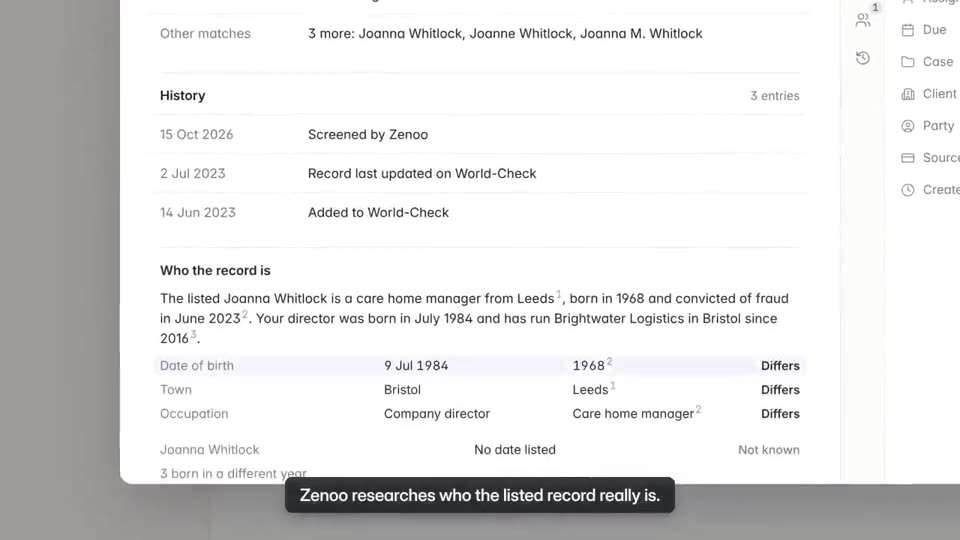
The result sits with screening and review on one case, so nobody checks a second tool to see the whole customer.
What you can build
- Detecting fraud rings and multi-accounting at sign-up using device signals
- Adding a silent device-risk layer to a wider onboarding decision
About Device-First Fraud Intelligence
FAQs
Device-First Fraud Intelligence questions.
How does SHIELD work with Zenoo?
Through a pre-built connector. Configure it in no-code Studio, add fallback logic, and get one contract and a unified audit trail across every provider in the flow.
Does SHIELD verify a customer's identity?
No, it assesses device and session risk rather than proving identity. Most teams pair it with identity and document verification in the same Zenoo flow.
Does it add friction for genuine customers?
No, its signals are gathered in the background with no user action, so honest applicants are unaffected while risky sessions are flagged for review.
Hands it to your team
Verification is the first step. Compliance Hub handles the rest.
Once a customer is verified, screening and review happen in Compliance Hub. A possible PEP match lands in your team inbox with the evidence and the full history beside it. Zenoo suggests, your team decides.
Pairs well with
 VeriffAdd document and biometric identity verification alongside device signals.CO
 ComplyAdvantageAdd sanctions and adverse media screening in the same flow.IF
 IDLive FaceAdd passive liveness to counter biometric spoofing.
Alternatives


Tomorrow, your case
Bring us a case that went wrong.
We will run it through Zenoo while you watch: the evidence, the decision, and the record your MLRO would want to defend.
30 minutes. Your data. No slides.