
Regula
Regula provides forensic-grade identity document verification, from software SDKs to hardware readers, that runs inside Zenoo onboarding flows.
At a glance
Overview
Regula overview
Regula builds document verification technology with roots in forensic document examination, covering MRZ, RFID chip, hologram, and UV analysis across thousands of identity document types. It suits banks, governments, and other regulated organisations where document authenticity genuinely matters, with cloud SDKs, on-premise deployment, and physical readers all available.
- Company
- Regula Forensics
- Category
- Document verification
- Strongest in
- Forensic-level document authenticity analysis
- Best fit
- Regulated, high-fraud-risk onboarding
Where it is strongest
Key strengths
What Regula does well.
Forensic-depth document checks
Community reports praise its ability to catch chip tampering and sophisticated forgeries that lighter-weight checks miss, using MRZ, hologram, and UV analysis.
High reported accuracy
Community reports cite document verification accuracy in the region of 98 to 99 percent.
Enterprise-scale throughput
Public reports describe deployments handling more than a million documents per month.
On-premise and hardware options
On-premise deployment and physical document readers are available for strict data residency requirements or in-person channels.
Who it suits
Best for
Where Regula fits, and what to plan for.
Honest notes on the trade-offs, each with a way to cover the gap inside a Zenoo flow.
- Banks, governments, and regulated industries needing forensic-level document authenticity checks
- High-fraud-risk onboarding where sophisticated forgeries are a realistic threat
- Organisations that need on-premise deployment or physical readers alongside digital flows
- Deeper integration than cloud-first tools. Community reports suggest more setup effort than lightweight cloud APIs. With Zenoo the connector is already built, so Regula drops into a flow without in-house SDK work.
- Hardware is optional, budget deliberately. Physical readers add cost and mainly benefit in-person channels. Digital-only teams typically take the software SDK route and keep flows mobile-first, reserving hardware for branch use cases.
- Depth can exceed low-risk needs. For low-risk, high-volume onboarding, forensic depth can be more than the risk profile requires. A common Zenoo pattern is a lighter first-pass check with risk-based routing of suspicious documents to Regula.
Open the customer's case
What your team sees
The Regula result, beside everything else.
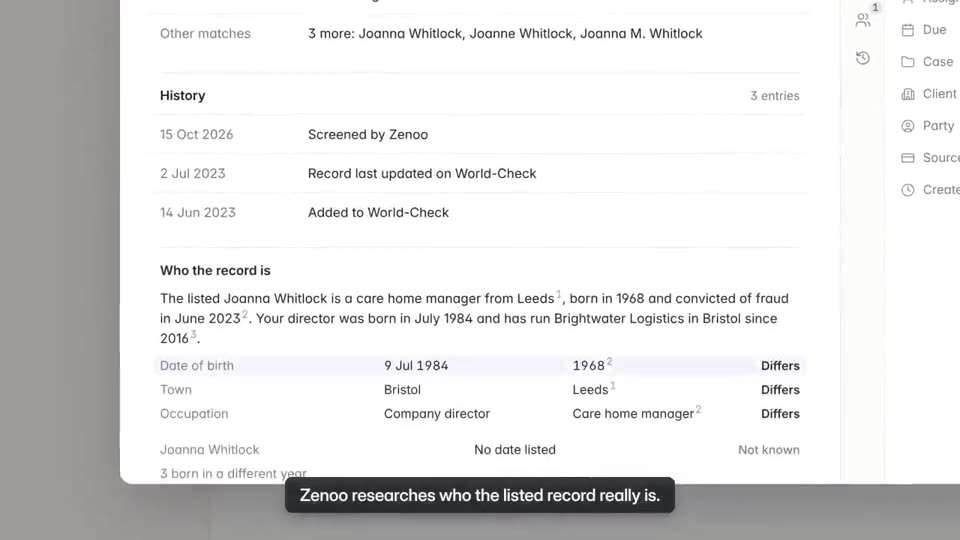
The result sits with screening and review on one case, so nobody checks a second tool to see the whole customer.
What you can build
- Deep authenticity checks on high-risk applications routed from a lighter first-pass provider
- Branch or counter verification with hardware readers feeding the same audit trail as digital onboarding
About Regula
FAQs
Regula questions.
How does Regula work with Zenoo?
Activate Regula from your Zenoo account. Zenoo's AI builds and tests the connector, typically within a day, so there is no integration project on your side. You get fallback routing to alternative providers, one contract covering every provider in your stack, and a unified audit trail across all of them.
Does Regula require hardware?
No. Digital onboarding uses the software SDKs and cloud services. Hardware document readers are an optional extra for in-person channels such as branches, borders, and counters.
When should I route checks to Regula rather than a lighter provider?
A common pattern is risk-based routing: a fast, low-cost provider handles the bulk of applications, and documents that trigger risk signals, or come from high-fraud corridors, are routed to Regula for forensic-level analysis. In Zenoo this is a routing rule, not custom code.
Hands it to your team
Verification is the first step. Compliance Hub handles the rest.
Once a customer is verified, screening and review happen in Compliance Hub. A possible PEP match lands in your team inbox with the evidence and the full history beside it. Zenoo suggests, your team decides.
Pairs well with
 FaceTecAdd 3D liveness detection so a verified document is matched to a live person.CO
 ComplyAdvantageAdd sanctions and AML screening in the same flow.AU
 AuthentiScanUse a low-cost first-pass check and route high-risk documents to Regula.
Alternatives
 IDVerseIdentity verification · LexisNexisAU
 AuthenticIDDocument verification · AuthenticID Inc.MS
 Mitek SystemsDocument verification · Mitek Systems, Inc.VE
 VeriffIdentity verification · Veriff OÜ
More in document verification




Tomorrow, your case
Bring us a case that went wrong.
We will run it through Zenoo while you watch: the evidence, the decision, and the record your MLRO would want to defend.
30 minutes. Your data. No slides.