Every new verification vendor is another integration project.
With ZenooOne API for every check. Results come back in one standard format, whichever provider ran it, and new vendors are added from the Marketplace.
For product and engineering · CTOs and product teams
Send applications in through one API and get results back by webhook, whichever identity, screening or registry vendor ran the check. Add or swap vendors from the Marketplace without rebuilding your flow. Compliance works the cases in Zenoo.
30 minutes. Your data. No slides.
What you answer for
How many integrations is this?
One API for every check, whichever vendor runs it.
Can we test it safely?
Separate staging and production environments, each with its own keys and provider connections.
How do we hear back?
Results and status changes come back by webhook.
Will security sign it off?
EU or US region, or a dedicated UK tenant, with AES-256 at rest and TLS 1.3 in transit.
Sound familiar?
Every new verification vendor is another integration project.
Compliance tickets compete with the product roadmap.
We cannot test the flow without touching production.
Security reviews take longer than the build.
One case, start to finish
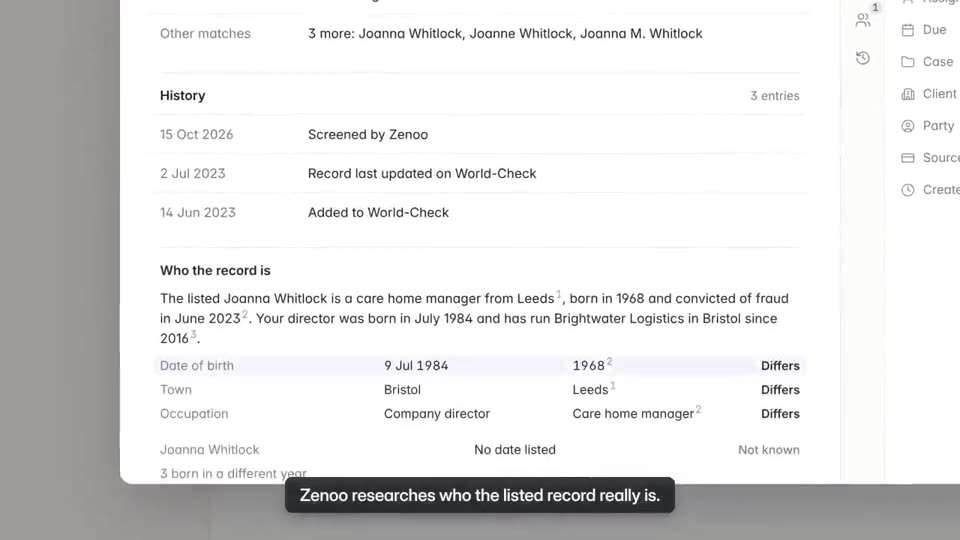
Follow one application through Zenoo, from your API call to the webhook that tells your product the customer is approved.
Nothing is cleared or added on its own.
Product screens show fictional data.
Where this fits
Your providers send their results in. Zenoo organises them and puts what needs you in the Inbox. You deal with it, tick it off, and the next one comes in. Pick providers from the Marketplace, or bring your own.
Your checksFrom the Marketplace
My inbox0 done
Zenoo suggests. You decide.
Zenoo AI
Inside Zenoo, compliance gets a suggestion on every item with its sources. A person makes every call, so your product never ships a decision a model made on its own.
Getting live
Send applications in through the API, or onboard customers through Zenoo's own journeys. Keep the data vendors you have, under your contracts, and add others from the Marketplace.
Browse the MarketplaceFour to six weeks to production is typical, depending on your providers and systems. It starts with a demo on a case you bring, then a pilot on real cases.
How buying worksIn the EU or US region, or on a dedicated UK tenant. Encrypted with AES-256 at rest and TLS 1.3 in transit. ISO 27001 certification is in progress.
Trust and securityQuestions
Send applications in through the API, or use Zenoo's own journeys. Results and status changes come back by webhook.
Yes. Separate staging and production environments, each with its own base URL, API keys and provider connections.
The ones you already use, under your contracts, and others from the Marketplace. Results come back in one standard format whichever provider ran the check.
A failed call is retried. If it still fails, the check does not pass. It goes to a person with the reason.
In the EU or US region, or on a dedicated UK tenant, encrypted with AES-256 at rest and TLS 1.3 in transit. ISO 27001 certification is in progress. See Trust and security.
Four to six weeks to production is typical, depending on your providers and systems. See how buying works.
Tomorrow, your case
We will run it through Zenoo while you watch: the evidence, the decision, and the record your MLRO would want to defend.
30 minutes. Your data. No slides.


