Spanish DNIe
Use Spain's DNIe electronic ID card for secure digital onboarding via Zenoo.
Checking your own ID? Zenoo is a service for businesses and cannot check a personal ID. Dirección General de la Policía can help.
The scheme at a glance
Overview
What is Spanish DNIe?
The Spanish DNIe (Documento Nacional de Identidad electrónico) is Spain's national identity card in its electronic form. It is issued by the Dirección General de la Policía under the Ministry of the Interior and is compulsory for Spanish citizens from the age of 14. Since 2006 the card has carried a chip holding authentication and digital signature certificates, and the DNI 3.0 version supports contactless reading over NFC from a mobile phone or tablet.
The DNI number is the primary identifier for Spanish citizens across banking, tax, and government services. It is made up of eight digits followed by a control letter that stays with the holder for life. Verification checks the number and the person's details against the Policía record and returns the holder's name, date of birth, nationality, and registry status.
If you already hold the person's identity data, you can pass it in when the check launches so the customer sees fewer steps. Zenoo returns a verified result with a full audit record to your case.
- Issuing authority
- Dirección General de la Policía (Ministry of the Interior)
- Country
- Spain
- Number format
- Eight digits followed by a control letter, for example 12345678Z
- Data returned
- Name, date of birth, nationality, and registry status
- Official status
- Compulsory national ID for citizens from age 14
Three steps
How it works
How verification works
The check runs in your flow. The result arrives where your team works.
Collect or pass in identity data
The person enters their DNI number and details, or you pass known data in at launch to skip the form.
Check against the Policía record
The DNI number and the person's details are matched against the Dirección General de la Policía record of issued documents.
Signals returned to your flow
A verified result, the returned name and date of birth, and a full audit record flow straight into your Zenoo case.
Open the customer's case
What your team sees
The Spanish DNIe result, beside everything else.
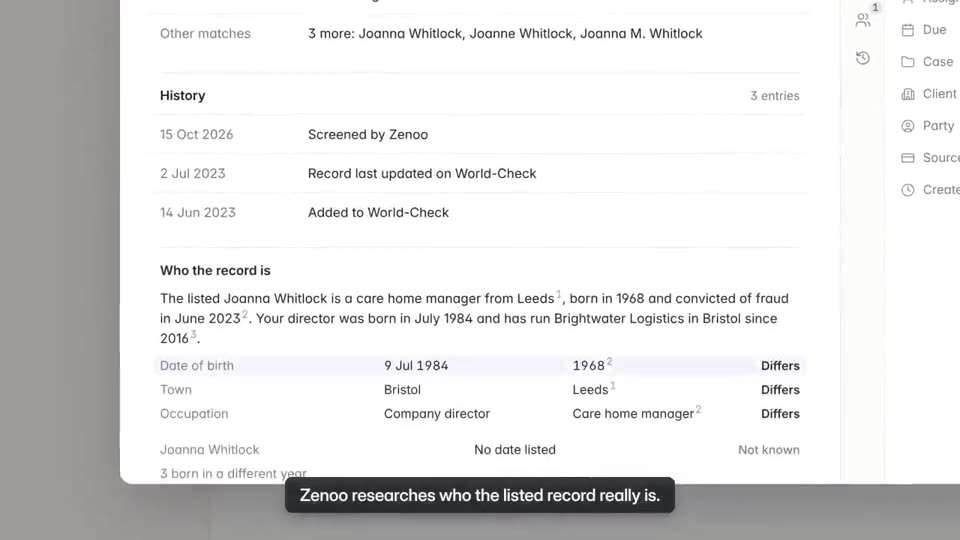
Verification sits with screening and review on one case, so nobody checks a second tool to see the whole customer.
What you can build
- Confirm a new customer's DNI before a bank account goes live.
- Verify Spanish residents during digital onboarding and e-KYC.
- Prove a lending applicant is who they claim before you extend credit.
- Check identity for government and public service access.
About Spanish DNIe
FAQs
Spanish DNIe questions.
How do I verify a Spanish DNIe identity?
Submit the DNI number and the person's details, or pass them in at launch. Zenoo checks the number against the Dirección General de la Policía record and returns a verified result with the holder's name, date of birth, and nationality.
Is the Spanish DNI mandatory?
Yes. The DNI is compulsory for Spanish citizens from the age of 14 and is the primary proof of identity for banking, tax, and government services.
What is the DNI number format?
A DNI number is eight digits followed by a single control letter, for example 12345678Z. The control letter is a checksum derived from the eight digits and stays with the holder for life.
Can I verify without the customer filling in a form?
Yes. If you already hold the person's identity data, pass it in when the check launches so the customer sees fewer steps, then Zenoo returns a verified result with a full audit trail.
Hands it to your team
Verification is the first step. Compliance Hub handles the rest.
Once a customer is verified, screening and review happen in Compliance Hub. A possible PEP match lands in your team inbox with the evidence and the full history beside it. Zenoo suggests, your team decides.
Pairs well with

Related schemes
Tomorrow, your case
Bring us a case that went wrong.
We will run it through Zenoo while you watch: the evidence, the decision, and the record your MLRO would want to defend.
30 minutes. Your data. No slides.