
Identity
Verify identity from the phone number with Zenoo integrated with Prove Identity, cross-referencing carrier and identity data in real time.
At a glance
Overview
Identity overview
Prove Identity verifies people using their phone number as the core signal, cross-referencing carrier and identity data to confirm a name, phone, and personal details match in real time. It suits onboarding flows that want a low-friction identity check anchored to a device the user already holds.
- Company
- Prove Identity, Inc.
- Category
- Phone verification
- Strongest in
- Low-friction, phone-anchored identity verification
- Best fit
- Consumer onboarding in strong phone-data markets
Where it is strongest
Key strengths
What Identity does well.
Phone-anchored verification
Uses the phone number and its authoritative carrier and identity data to confirm identity, which lets many users pass with minimal typing and no document upload.
Low friction at onboarding
Because the check runs against data the user already has, it can shorten sign-up and reduce drop-off compared with a full document-and-selfie flow.
Real-time results
Identity checks return quickly, which suits high-volume consumer onboarding where speed affects conversion.
Reusable across the journey
The same phone-centric identity signal underpins later authentication, so onboarding and returning-user checks share one approach.
Who it suits
Best for
Where Identity fits, and what to plan for.
Honest notes on the trade-offs, each with a way to cover the gap inside a Zenoo flow.
- Consumer fintech and banking onboarding that wants minimal typing
- Markets where mobile-number data coverage is strong
- Flows that want to reduce document uploads for low and medium-risk users
- Depends on phone-data coverage. Assurance relies on authoritative mobile data, which is strongest in Prove's core markets, notably the United States. For thin-file users or weaker-coverage regions, pair a document or eID check in the same Zenoo flow.
- Not a full document check. It confirms identity data rather than authenticating a physical document. Higher-risk journeys, or those with a regulatory document requirement, should layer document verification alongside it, which Zenoo can trigger conditionally.
- Number changes and new numbers. Very new numbers or recent SIM changes can lower assurance. Route those cases to step-up verification rather than failing the user outright.
Open the customer's case
What your team sees
The Identity result, beside everything else.
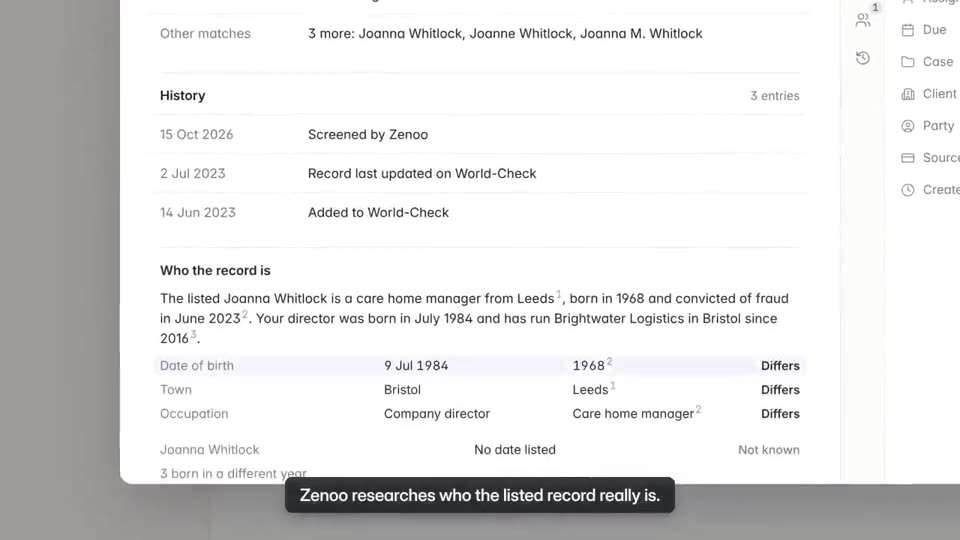
The result sits with screening and review on one case, so nobody checks a second tool to see the whole customer.
What you can build
- Low-friction consumer onboarding anchored to the phone number
- Pre-filling and confirming identity data before a document step
- Reducing document uploads for low and medium-risk applicants
About Identity
FAQs
Identity questions.
Can Prove Identity replace document verification?
For lower-risk users in strong-coverage markets it can carry the identity check on its own. For higher-risk journeys or where a document is required by regulation, run document verification alongside it, which Zenoo triggers conditionally.
What happens to users with poor phone-data coverage?
Zenoo routes them to a fallback such as document or eID verification in the same flow, so a thin-file user is stepped up rather than rejected.
Hands it to your team
Verification is the first step. Compliance Hub handles the rest.
Once a customer is verified, screening and review happen in Compliance Hub. A possible PEP match lands in your team inbox with the evidence and the full history beside it. Zenoo suggests, your team decides.
Pairs well with
AuthReuse the phone-anchored signal for passwordless returning-user authentication.DA Document AuthenticationAdd document verification for higher-risk users or regulatory document requirements.CO
 ComplyAdvantageAdd sanctions, PEP, and adverse media screening in the same flow.
Alternatives
 SocureFraud prevention · Socure, Inc.TR
 TruliooIdentity verification · Trulioo Information Services Inc.EKEkataData providers · Ekata (Mastercard)TE
 TelesignPhone verification
More in phone verification
Tomorrow, your case
Bring us a case that went wrong.
We will run it through Zenoo while you watch: the evidence, the decision, and the record your MLRO would want to defend.
30 minutes. Your data. No slides.