Every alert lands in one risk-ranked inbox and every case runs one structured workflow, so your team approves good customers quickly and shows exactly who decided, who signed, and why. Live on your data in 4 to 6 weeks, working with your existing SSO, permissions, and access controls.
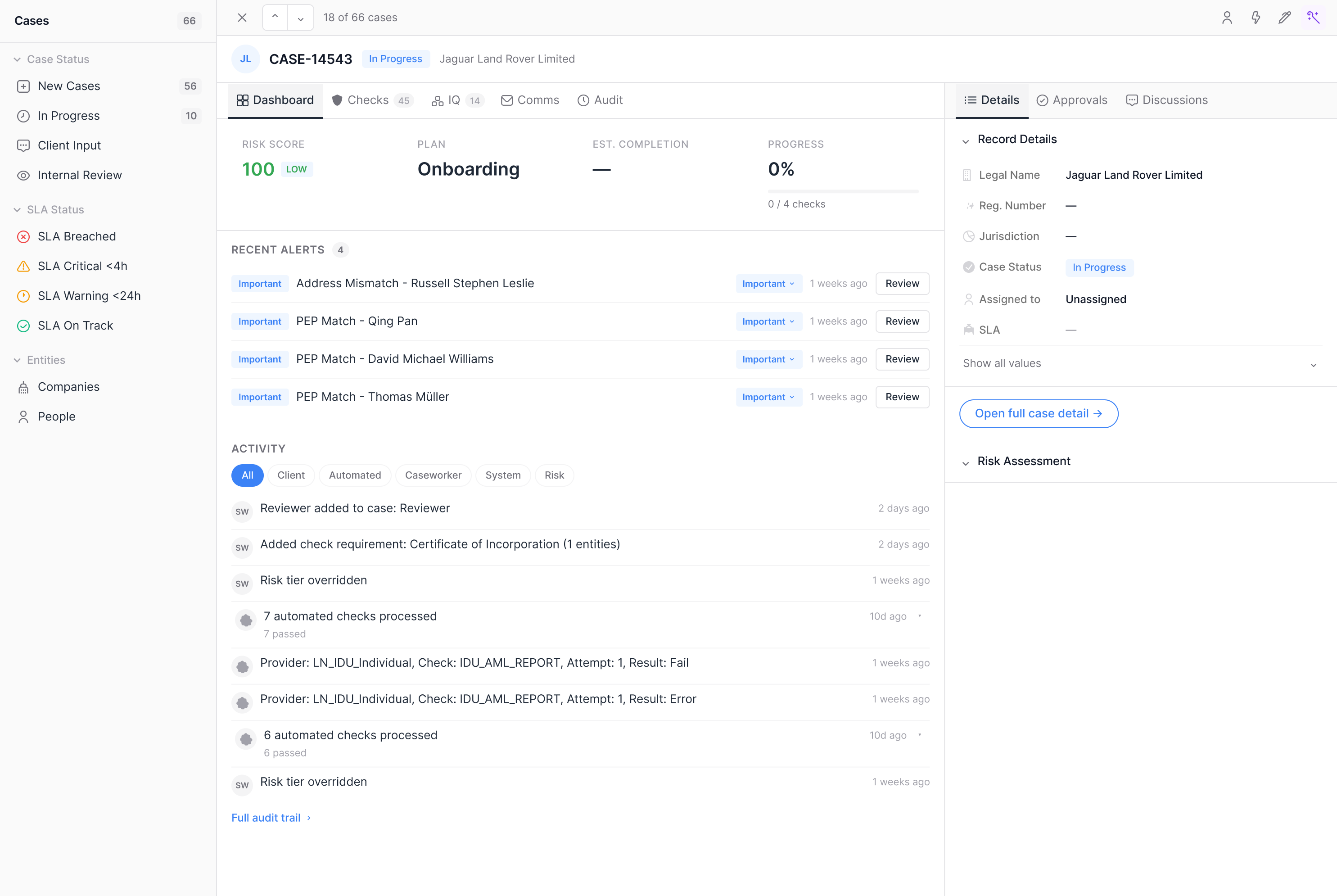
One inbox and one configurable seven-status case workflow that replaces the six to eight disconnected tools most teams stitch together. Manage cases, risk, and referrals in one place, with four-eyes sign-off and watched SLAs, so compliance stops being the queue the business waits behind.
“The tension between meeting our corporate obligations and providing a luxury service, resolved, with real-time feedback to sales and lost sales avoided.”
Clean cases clear themselves, the ranked inbox surfaces what matters, and every high-risk decision is proved to the name.
Orchestrated screening and your configured rules clear what should clear, and only the exceptions reach an analyst. Each clearance is written to the audit trail with its reasoning and the rule that fired.
Runs across 53 pre-integrated vendors.
Alerts are ranked on the FATF four dimensions so the highest-risk, closest-to-breach case sits at the top and the analyst works down, each case carrying entity detail and vendor verification on one screen instead of five.
The industry problem this fixes: 95% of every alert a human reviews is a false positive (industry benchmark; Accenture, McKinsey, ACAMS).
The maker acts, a separate checker approves, neither can be the same person, and both are recorded as named users in a write-once trail you export in one click.
Captured across 32 immutable event types, mapping to maker-checker regimes such as the FCA Senior Managers regime.
Every case carries an SLA by risk tier, the clock pauses while you wait on the client, and a looming breach escalates and emails the manager automatically.
SLA breaches found after the fact cut from 23% to under 3% (platform benchmark).
Under every case, a tamper-proof trail across 32 event types you export for a regulator in one click. Above every case, an SLA that escalates before it breaches. That is what having your back looks like.
Screening runs across the vendors you already trust, and every result lands inside the case, so the analyst reviews one screen, not five tabs. 53 pre-integrated vendors, 240+ check types, 209 countries.
See the marketplace ›In Zenoo Labs we are testing AI that investigates the case before your analyst opens it. Ten specialised agents gather intelligence, cite sources, and challenge their own conclusions with a Red Team check. In alpha and beta with design partners, human-in-the-loop and opt-in, never an automatic decline.
“The tension between meeting our corporate obligations and providing luxury service, resolved, with real-time feedback to sales and lost sales avoided.”
Named reference available privately, on request, once the client approves. The same discretion we would give you.
Cases are ranked on the FATF four dimensions: the combination of risk score, SLA proximity, and entity-level flags. The highest-risk, closest-to-breach case surfaces first. The analyst works down the ranked list rather than triaging an undifferentiated queue, which concentrates effort where the decision matters most.
A maker is the analyst who acts on a case. A checker is a separate named user who approves that decision. The system enforces that the maker and checker cannot be the same person. Both names, timestamps, and stated reasoning are written to an immutable audit trail and can be exported in a single click, with no manual reconstruction needed.
Yes. The clock pauses on client-pending status and resumes when the client responds. This means SLA performance reflects time within your control, and a looming breach triggers an escalation to the case manager automatically before it becomes a finding.
Cases that do not match a straight-through clearance rule are placed into the ranked inbox for analyst review. The analyst sees the entity, the vendor evidence, and the screening results on one screen. Nothing that touches an analyst is quietly discarded. Every case follows the same structured seven-status workflow and is recorded in full.
Events are written once and cannot be edited or deleted. Each of the 32 event types carries a millisecond timestamp and is associated with a named user. The result is a record that maps directly to the requirements of maker-checker regimes such as the FCA Senior Managers regime, and that can be exported for a regulator without manual reconstruction.
Standard case management runs without any AI. In Zenoo Labs, which is in alpha and beta with design partners, we are testing AI agents that investigate a case before your analyst opens it, pulling registry data, ownership chains, adverse media, and jurisdiction risk into a research brief. The analyst still makes the decision. Labs is opt-in and human-in-the-loop at every step.
Bring your Monday inbox and the rules you run today. We will show you how your team owns them in Zenoo, in 30 minutes.