
Dentity
Verify identity with Dentity's digital ID platform.
Checking your own ID? Zenoo is a service for businesses and cannot check a personal ID. Dentity can help.
The scheme at a glance
Overview
What is Dentity?
Dentity is a digital identity platform that lets people create a verified identity once and reuse it across the services they sign up for. Rather than being a government-issued national ID, it is a private, standards-based scheme built on W3C verifiable credentials and decentralised identifiers, so the person holds their credential in a wallet and chooses which attributes to share.
To become verified, a person completes an identity check with a valid government-issued document and a liveness selfie. Once verified, they hold a reusable identity credential they can present to any business that accepts Dentity, sharing only the fields required for that transaction on their consent.
For a Zenoo flow, the person authenticates with Dentity and consents to share their verified identity credential. Zenoo receives the confirmed result and the attributes shared, then records them against the case.
- Issuing authority
- Dentity, a private digital identity provider
- Country
- United States, used internationally online
- Identifier
- A reusable identity credential held in the person's Dentity wallet
- Standards
- W3C verifiable credentials and decentralised identifiers (DIDs)
- Data returned
- Verified identity attributes such as name and date of birth, shared on consent
- Official status
- Private reusable identity scheme, not a compulsory national ID
Three steps
How it works
How verification works
The check runs in your flow. The result arrives where your team works.
Person verifies once with Dentity
The person creates a verified identity by presenting a government-issued document and a liveness selfie, which Dentity holds as a reusable credential in their wallet.
Person shares the credential on consent
When they reach your flow, the person authenticates with Dentity and consents to share the verified attributes you need, such as name and date of birth.
Signals returned to your flow
A verified result, the shared identity attributes, and a full audit record flow straight into your Zenoo case.
Open the customer's case
What your team sees
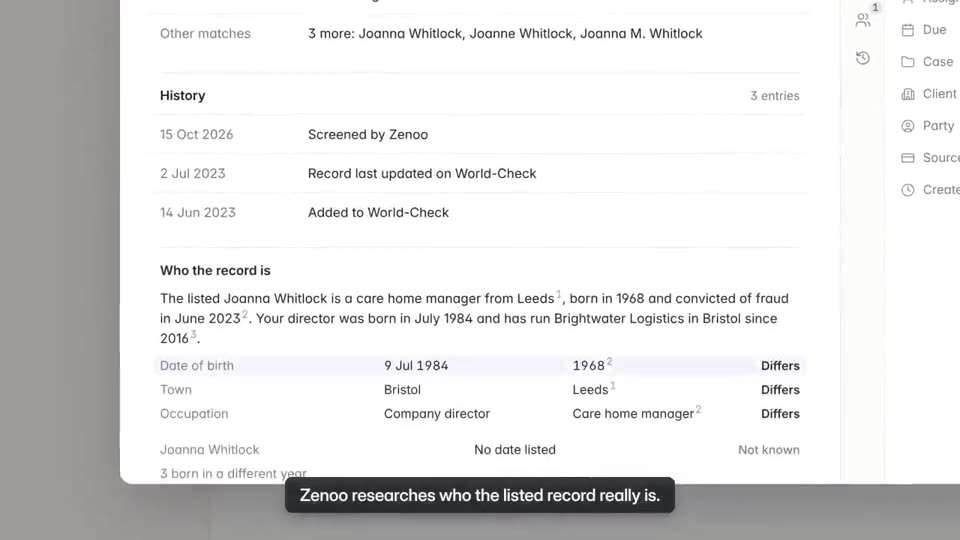
The Dentity result, beside everything else.
Verification sits with screening and review on one case, so nobody checks a second tool to see the whole customer.
What you can build
- Reuse an existing verified identity to onboard a customer without repeating document capture.
- Confirm a new customer's name and date of birth before a financial account goes live.
- Verify buyers and sellers on a marketplace before they transact.
- Check that an applicant is a real, verified person during account sign-up.
About Dentity
FAQs
Dentity questions.
How do I verify a Dentity identity?
The person authenticates with their Dentity wallet and consents to share their verified identity credential. Zenoo then receives the confirmed result and the attributes shared, such as name and date of birth, with a full audit trail.
What data does Dentity return?
Dentity returns verified identity attributes that the person chooses to share, such as name and date of birth. Because it uses verifiable credentials, only the fields needed for the transaction are disclosed rather than the full underlying document.
Is Dentity a government-issued national ID?
No. Dentity is a private digital identity platform built on open standards, not a compulsory national scheme. People verify once with a document and selfie, then reuse the resulting credential across services that accept Dentity.
Hands it to your team
Verification is the first step. Compliance Hub handles the rest.
Once a customer is verified, screening and review happen in Compliance Hub. A possible PEP match lands in your team inbox with the evidence and the full history beside it. Zenoo suggests, your team decides.
Pairs well with

Related schemes
Tomorrow, your case
Bring us a case that went wrong.
We will run it through Zenoo while you watch: the evidence, the decision, and the record your MLRO would want to defend.
30 minutes. Your data. No slides.